

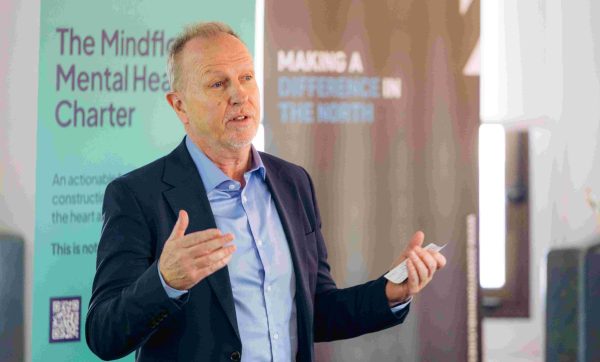
Former England footballer and Mindflow CEO Trevor Steven has called on the construction sector to take stronger action on workplace mental health following the launch of a new Mental Health Charter designed to help businesses move from awareness to meaningful change.
Launched on World Mental Health Day on 10 October, the Mindflow Mental Health Charter provides construction organisations with a practical framework to improve mental health support, create healthier workplace cultures and measure progress over time.
The initiative has already been adopted by several major construction companies, including Balfour Beatty, Volker Stevin, Graham Group and Sisk, with Mindflow now encouraging businesses of all sizes to sign up and commit to the Charter’s principles.
Developed from Mindflow’s experience working across construction sites and backed by a long-term research partnership with the University of Warwick, the Charter outlines ten core principles aimed at helping organisations strengthen their approach to mental wellbeing.
The framework is intended to support leaders and managers in creating workplaces where mental health is recognised as a business priority, encouraging earlier conversations around wellbeing and ensuring employees can access support when it is needed.
At its core, the Charter seeks to embed positive mental health practices into everyday operations rather than treating them as a separate initiative.
Trevor Steven said the industry’s success in improving health and safety standards demonstrates what can be achieved when businesses unite behind a common goal.
“Construction has made significant progress in health and safety because the industry came together, set expectations and made improvements part of everyday working life,” he said.
“We believe mental health deserves that same level of commitment.
“We know the conversation around mental health is starting to open up across construction, and that is an important first step. Now, the industry must turn those conversations into action: practical, consistent support that helps people speak openly and get help early when they need it.”
Steven said the new Charter is intended to provide a clear route for organisations looking to develop a more structured approach to mental health.
“The Mindflow Charter gives businesses a clear, practical route to take that next step,” he said. “We are inviting construction businesses to become Charter registered and start their journey working towards systemic change within the industry.
“Every company that completes the self-assessment and takes its place on the Charter Register is sending its people an important message: your mental health matters here, just as much as your safety does.”
The construction industry has increasingly recognised the importance of mental health in recent years, with concerns ranging from workplace stress and long working hours to the broader impact of poor wellbeing on productivity, retention and safety.
While awareness campaigns have helped increase discussion around mental health, Mindflow believes many businesses are now looking for practical guidance on how to turn good intentions into effective action.
The Charter is designed to meet that need by providing a structure that organisations can follow, assess and improve over time. Participating businesses complete a self-assessment process and are then included on the Charter Register as they work towards implementing the principles.
Mindflow hopes that widespread adoption will encourage a more consistent industry-wide approach to supporting mental wellbeing and create opportunities for organisations to learn from each other’s experiences.
A key part of the initiative is its research partnership with the University of Warwick, which will independently assess how the Charter is implemented and evaluate its impact as participation increases. The collaboration is expected to build a growing body of evidence around effective mental health interventions within construction and identify areas where further improvements are required.
By combining practical guidance with independent academic evaluation, Mindflow aims to help create long-term, measurable change across the sector.
The charity believes that, just as safety has become a cornerstone of construction culture, mental wellbeing should be viewed as a fundamental part of responsible business practice.
Construction companies interested in joining the initiative can complete the Charter self-assessment and register their commitment through Mindflow’s website. The organisation hopes that increasing participation will help establish a shared standard for mental health support across the industry and contribute to healthier workplaces for thousands of construction workers nationwide.
To find out more about the Mindflow Mental Health Charter, complete the self-assessment and register your commitment, visit: https://mindflow.charity/charter/join.