

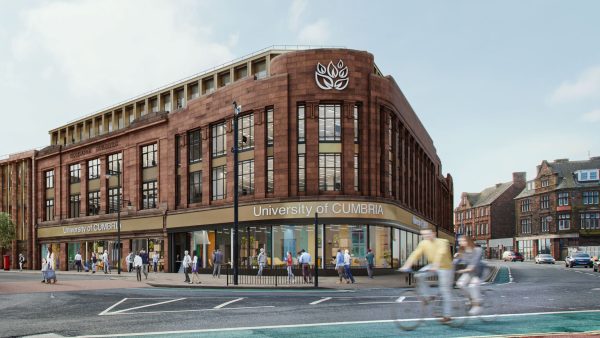
A major milestone has been reached in the delivery of the University of Cumbria’s proposed Carlisle Citadels campus, with funding secured and a construction contract agreed with contractor GRAHAM ahead of work beginning in early 2027. The announcement marks significant progress for the £85.2m regeneration project, which will transform the heart of Carlisle while preserving an important part of the city’s architectural heritage.
Central to the plans is the retention of the distinctive sandstone façade of the former Woolworths building on English Street and Victoria Viaduct. The decision follows public feedback during the planning process, with many residents expressing concerns about the potential loss of one of the city centre’s most recognisable historic features.
Architects working on the development have incorporated the 1930s frontage into the design of the new campus, ensuring the landmark remains part of Carlisle’s streetscape for future generations.
The university says extensive preparations are now under way to support the façade during the demolition and construction phases. Subject to planning approval, hoardings and specialist scaffolding structures will be installed along the building, while temporary traffic measures will be introduced throughout much of the construction programme.
Subject to the remaining legal, financial and governance approvals being completed, the University of Cumbria aims to open the new Citadels campus in 2029, welcoming its first intake of students for the 2029/30 academic year.
Professor Julie Mennell, Vice Chancellor of the University of Cumbria, said the project had overcome a range of challenges over several years. “This multi-partner project in the centre of Carlisle has been complex, not least given the multiple challenges the external environment has presented over a number of years,” she said. “All those involved, across the university and our partners, can be rightly proud of the significant commitment, work and resilience demonstrated to get us to this historic point.
“As we near the beginning of the construction phase, and after listening to the public’s request not to lose this piece of Carlisle’s past, we have worked with Cumberland Council, GRAHAM and others on the mitigation measures that will help manage this important period.”
Cumberland Council Leader Mark Fryer described the development as a transformative investment for the city. “We are delighted to support this landmark project as it moves towards this important stage,” he added. “The Citadels development represents a significant investment in Carlisle’s future, creating new opportunities for learning, innovation and economic growth in the heart of the city.
“It is equally important that, as we invest in Carlisle’s future, we respect and protect the city’s heritage. Retaining the historic Woolworths façade will preserve a familiar part of the city centre while allowing this important regeneration project to move forward.”
GRAHAM Regional Director, Peter Reavey, said the project would require specialist engineering and careful planning: “Building a modern university campus around a historic sandstone frontage in a busy city centre takes specialist engineering and careful planning. We’ve drawn on our experience of delivering complex projects on constrained sites and worked closely with the University of Cumbria and its stakeholders to prepare for the main construction phase.
“The design blends the historic sandstone frontage with contemporary architecture, celebrating Carlisle’s rich heritage while creating new spaces for learning, research and innovation.”
Most of the funding for the wider Carlisle Citadels project is being provided by the Ministry of Housing, Communities and Local Government through the Borderlands Inclusive Growth Deal. Cumberland Council is contributing more than £5.2m through the Carlisle Town Deal Fund, while the University of Cumbria has committed £15.5m.
The development forms a key part of the university’s Towards 2030 strategy, which has already seen the creation of the Pears Cumbria School of Medicine and the opening of a new campus in Barrow-in-Furness.
Once complete, the Citadels campus is expected to become a major hub for learning, research and innovation, bringing new activity and investment to Carlisle city centre while preserving one of its most recognisable historic frontages.
Further details about the University of Cumbria’s Towards 2030 strategy, including the Citadels area development, can be found online at www.cumbria.ac.uk/t2030.