

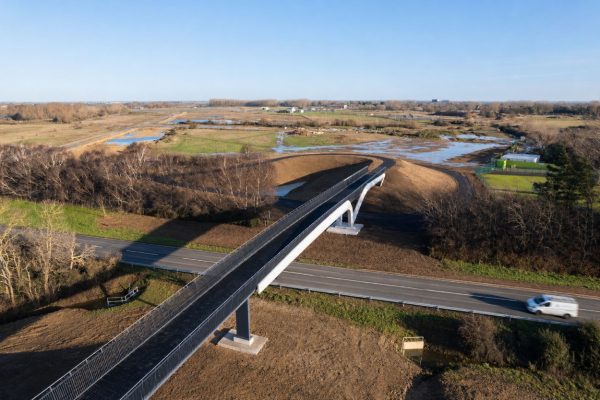
Construction and civil engineering company GRAHAM has completed a new pedestrian, cycle and equestrian bridge over the A10 in Cambridgeshire, delivering a traffic-free connection between Waterbeach New Town and Cambridge Science Park, as well as the city centre.
Commissioned by developer Urban&Civic as part of the Waterbeach New Town development, the 90-metre-long steel bridge weighs 150 tonnes and has been designed to provide a safe and accessible route for a wide range of users. The structure was formally opened by Charlotte Cane MP, Member of Parliament for Ely and East Cambridgeshire, marking the completion of a significant piece of active travel infrastructure for the region.
GRAHAM was appointed principal contractor in early 2025, with construction work beginning in February of that year. The project involved extensive planning and coordination to safely deliver a major structure over one of the county’s busiest roads while maintaining traffic flows throughout the construction programme.
A significant element of the delivery strategy centred on off-site manufacture and modular construction techniques. The bridge was fabricated in sections at a specialist steel fabrication facility before being transported to site and assembled using large mobile cranes during carefully planned road management operations. By manufacturing key components away from the site, the project team was able to improve quality control, reduce on-site construction activities and minimise disruption to road users during installation.
The bridge was lifted into position in a series of modular sections, allowing works to be completed over shorter periods than would have been possible using traditional construction methods. This approach reduced the number of road closures required and improved safety by limiting the amount of work taking place directly above the carriageway.
Spanning the full width of the A10 carriageway, the structure is supported by reinforced concrete foundations and integrated approach embankments on either side. These landscaped embankments have been designed with gentle gradients to create a fully accessible crossing for cyclists, pedestrians, wheelchair users, families with pushchairs and horse riders, while also helping the bridge integrate naturally into its surroundings.
The bridge’s design has been influenced by Waterbeach’s aviation heritage, with sculpted edge beams and carefully detailed deck and parapet elements combining to create a distinctive profile within the surrounding Cambridgeshire landscape. Durable materials and protective coatings have also been incorporated to ensure the structure can withstand long-term use while minimising future maintenance requirements.
The new crossing removes the need for residents, commuters and equestrians to negotiate the A10 at road level, a route that has historically presented challenges for those wishing to travel actively and safely. By creating a dedicated crossing separated from traffic, the scheme significantly improves safety and accessibility for both existing and future communities.
Residents of Waterbeach New Town can now access Cambridge city centre by bicycle in around 25 minutes using the upgraded Mere Way route, which is predominantly off-road. The bridge also improves access to employment hubs including Cambridge Science Park, educational facilities, local services and leisure destinations, making active travel a more practical option for daily journeys.
The infrastructure is expected to benefit a broad range of users, from commuters travelling into Cambridge and schoolchildren accessing local education facilities through to families seeking safer recreational routes and equestrians travelling between existing bridleway networks. By encouraging more journeys to be undertaken on foot, by bicycle or on horseback, the crossing is also expected to help reduce reliance on car travel and support wider sustainability objectives across the area.
Andrew Henry, contracts director at GRAHAM, said: “The A10 bridge is a strong example of what civil engineering can do when the brief is genuinely focused on community benefit.
“Fabricating the structure off-site and lifting it into position allowed us to deliver with minimal disruption to one of the region’s busiest roads, and the result is infrastructure that will be used daily by thousands of people for decades to come. It has been a collaborative effort, and the opening is a well-earned milestone for everyone involved.”
The bridge is a key component of wider transport investment being delivered across Waterbeach New Town, supporting sustainable travel options and improving connectivity between the development and the surrounding region.
Fiona Reardon-Rose, communications and partnerships manager at Urban & Civic, said: “This bridge is a fantastic addition for both current and future residents at Waterbeach, providing a safe and convenient connection across the A10 and making it easier to travel to Cambridge and the surrounding area by foot, bike or horse.
“It’s a key piece of infrastructure that will support more sustainable journeys and help connect our growing community to jobs, services and opportunities. GRAHAM has been an excellent partner throughout the project, delivering a high-quality bridge with professionalism and minimal disruption.”
The crossing forms part of a broader package of transport infrastructure improvements at Waterbeach New Town, which also includes enhanced walking and cycling routes, improved bus services and a sustainable travel hub offering bike hire and community facilities. Together, these investments are intended to encourage greater use of sustainable transport while supporting the continued growth of one of Cambridgeshire’s largest new communities.
As Waterbeach New Town continues to develop, the bridge is expected to play a central role in connecting new neighbourhoods with employment, education and transport networks across Greater Cambridge. The project represents a long-term investment in sustainable mobility, providing infrastructure that will serve the community for decades while supporting ambitions for healthier, lower-carbon and better-connected travel across the region