

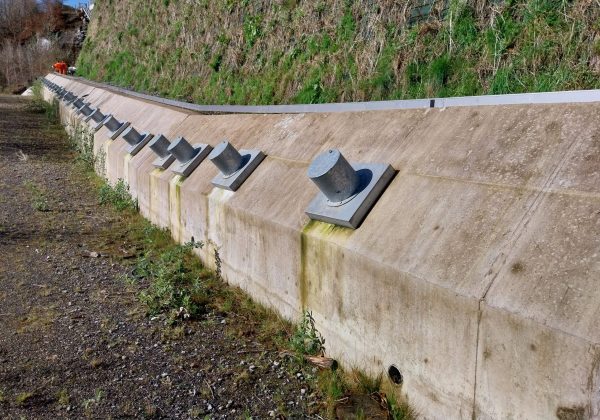
The resilience of UK infrastructure has garnered importance as the country’s population increases and developable land diminishes. As Matthew Keeshan, Technical Manager at construction and infrastructure technology specialists, DYWIDAG, points out in this article, it’s therefore crucial that our future built environment is imbued with greater sustainability; its longevity being vital to preserving natural spaces, tackling climate extremes and optimising public finances.
Geotechnical engineering has a vital role to play in overcoming the UK’s ‘small island’ issue and fulfilling future building needs. Limited space means brownfield sites and land containing variable and challenging ground conditions – such is the capricious nature of UK soil – will increasingly be sought for development.
UK ground conditions can change dramatically over a short distance. In some areas, London clay, chalk, limestone, alluvium and mudstone coexist beneath the surface. This complex yet natural phenomenon, which is exacerbated by harsher weather trends, underscores the challenge in incorporating durability as a design driver for future building projects. It’s a challenge geotechnics must rise to – the sector has to be capable of making difficult ground work, as ideal sites will be in shorter supply as years pass.
Digging deeper for greater stability
In practical geotechnical terms, enabling deeper foundations is likely to become more prevalent in order to engineer a surer footing for new buildings. This would allow near-surface soils, weakened by wetter, more aggressive environments, to be bypassed during initial construction. As a result, larger, higher-capacity bars of between 40mm and 100mm will gain further ground as staple support for projects of greater depth.
Engineered solutions, such as double corrosion protection (DCP) will become increasingly important as excavations extend within saturated ground. Innovated by DYWIDAG, DCP provides independent, physical barriers between high-strength steel bars and the surrounding installation environment (soil, groundwater, or corrosive air) to protect critical load-bearing elements.
Preparing the ground for UK renewable transition
Evolving larger diameter bars will also be integral to geotechnical engineering’s trend towards shoring up the UK’s ageing coastal infrastructure, as well as the onshore/offshore wind systems, ports and substations that are core to the government net-zero ambition. Geotechnical expertise will be required to navigate the installation of hundreds of miles of transmission lines that will transport the cleaner energy to Britain’s towns and cities. And with the structural integrity of major nuclear power stations such as Hinkley Point and Sizewell also dependent on specialised formwork and ground anchoring solutions, it could be said that much of the UK’s energy transition will stand or fall on the geotechnical decisions made today.
Geotechnical training to meet future building needs
In the coming decade, geotechnical insights and labour will be in high demand, largely driven by the aforementioned renewable energy transition. The work will involve applying mostly established, rather than revolutionary, geotechnical techniques on a large scale. Yet, there is a concern that a geotechnical training and knowledge gap could be a barrier to delivering essential building projects effectively.
Geotechnics is a niche construction element, but it is a vital one. Pioneers who evolved the sector as a discipline and devised the key codes and standards have retired or moved on, and their expert knowledge hasn’t necessarily been passed on to the following generation.
Additional geotechnical training would improve communication between engineers and contractors, enhancing teams’ ability to identify settlement issues including slope instability, or unexpected ground movement before serious incidents occur.
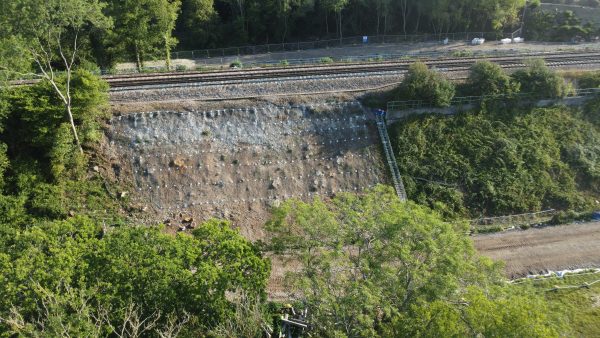
Without a deliberate focus on training, mentoring and knowledge transfer, unpaid consultants and established manufacturers such as DYWIDAG are increasingly commissioned for their geotechnical knowhow to prevent critical assets from being under-engineered. Ultimately, better-trained professionals deliver stronger, safer, and more reliable infrastructure.
In summary, infrastructure projects are becoming more complex due to increasingly challenging ground conditions, spatial issues, asset life expectations and strict sustainability requirements. This places greater emphasis on geotechnical engineers during a project’s design and construction phases. Ensuring they are equipped with the necessary geotechnical skills and experience through knowledge sharing, education and collaboration across the wider construction industry will support future infrastructure remaining safe and serviceable. It will be our long-standing legacy for the generations to come.
For information on DYWIDAG products and services, visit: dywidag.com.